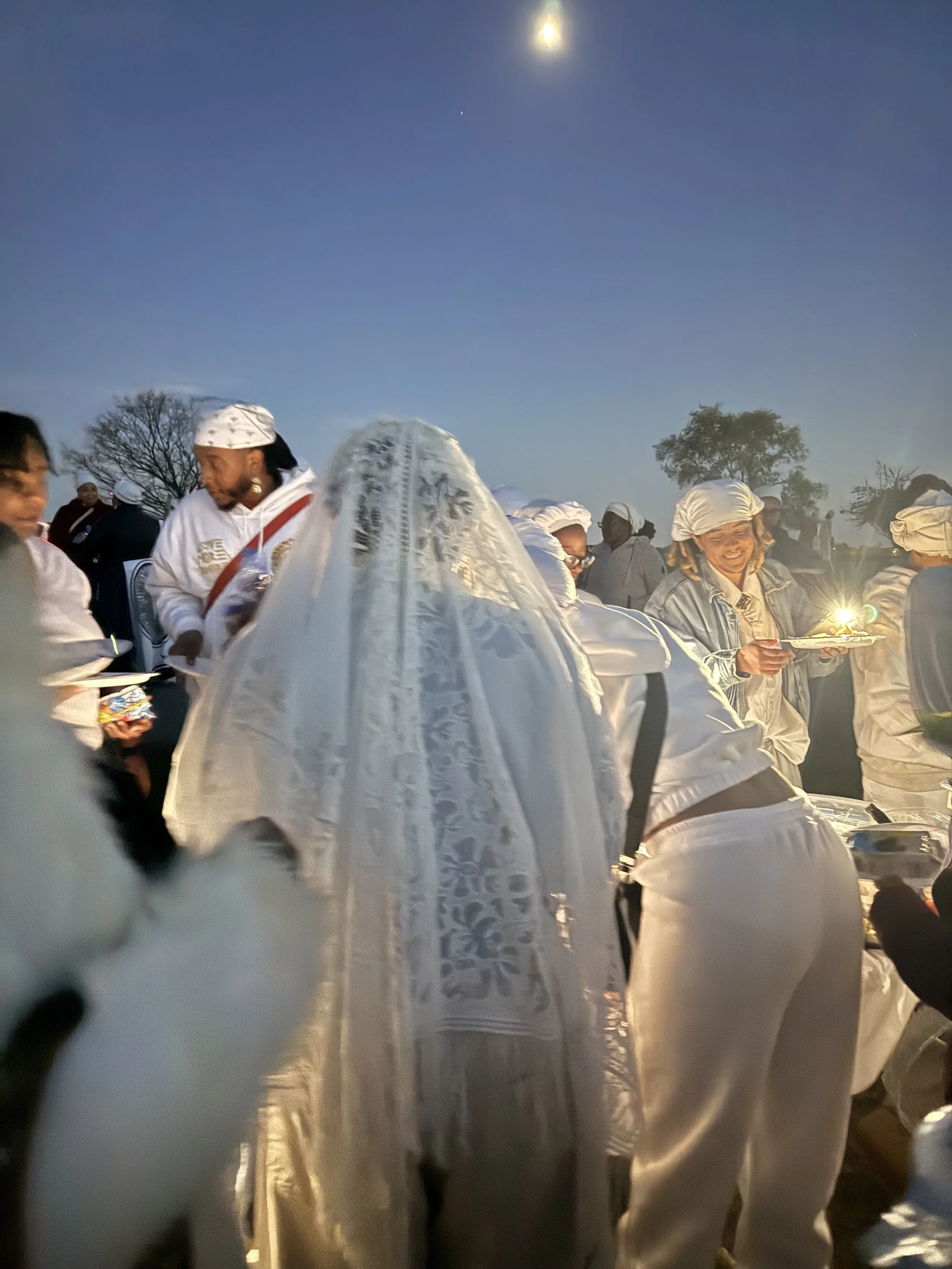
We require your humanness.
What It Means to Gather as Human, as Hoodoo.
People may ask why we ask people to come together in person when so much connection now happens online, and we understand the question because we also live in this world and use the same tools. We have social media, we host online conversations, and we meet on Zoom or Google Meets when it serves communication and access. These tools help us stay connected (if not overwhelmed), but they do not replace how we understand membership.
Why does membership into Chesapeake Conjure Society require coming to an in-person event first?
Membership, as we practice it, includes more than human beings. It consists of the places where we gather and the land that holds those places, along with plants, trees, animals, waters, sentient and non-sentient, and other forms of life that shape how Hoodoo exists in this specific region. These are participants in the work, whether people speak of them directly or learn of their presence over time. Because of this, gathering in person also means gathering in place.
When people come to our in person events they encounter a living environment with history, memory (sometimes contested), and sensorial conditions that cannot be experienced through screens. They encounter others who live in a relationship with that environment and who understand Hoodoo as something practiced within a wider living world instead of apart from it. Hoodoo developed through close relationships among people and between people and their surroundings, and knowledge moved through observation, occasional correction, and shared experience as opposed to explanation alone.
Learning unfolded within genuine relationships that included land and life beyond the human, and those relationships shaped how Hoodoo responsibility and care were understood.
Community forms through return and recognition (repetition). As people begin to know one another over time and understand how their
presence affects others, it shapes the texture of community in real life and in real time. In shared space familiarity with others builds, and accountability becomes part of daily interaction rather than an abstract idea. This helps for care and repair to remain possible.
Our understanding of Hoodoo also begins with how we understand what it means to be human.
A human does not arrive complete, a human becomes through time spent with others and through ongoing contact with the world that holds human life. Being human involves both ability and limitation. Humans act in the world through choice, labor, and speech, and sometimes magic, yet they also depend on forces they do not control and often do not fully understand. Hoodoo recognizes this condition without trying to resolve it. Hoodoo understands humanity as something shaped through relationship rather than independence.
We live within land and weather and water and other forms of life that respond to human presence whether acknowledged or ignored. Because of this, we carry responsibility for how they move through the world and how we take from it and how we listen to what surrounds us. Human life unfolds inside a wider field of life rather than standing apart from it.
Hoodoo also understands that human life does not end with death. The dead remain human while occupying a different position within the world. Ritually, us "living" act through physical presence and daily decision-making. Us, when dead, act through memory, influence, and continuity, shaped by experience and passage through time. These forms of action differ, yet they remain connected. They remain some of the most human-like burdens. Responsibility takes a different shape across these states. We living humans carry responsibility for care and repair within the present moment. When we're dead we carry responsibility for guidance and warning shaped by what they have already lived. Again, neither replaces the other. Balance depends on the relationship between the living and the dead rather than separation.
Communication across this boundary carries a burden. We are beholden to each other in this life cycle. Everything is circular. Listening matters as much as speaking. Attention matters as much as intention. Within this understanding, us humans hold agency without standing at the center of everything. Human action matters while remaining accountable to forces that go beyond individual desire. For instance, place shapes human life. Other forms of life shape human possibility. Time shapes what humans can know. See, we are not separate from the natural world, we are at once submissive to it and able to impact it greatly.
To be human within Hoodoo means learning to live with consequences and connection across generations and forms of being. This understanding shapes how we living (and sometimes dead) people gather, how ritual knowledge moves, and how responsible we are to each other/all of this beyond abstract theory. Hoodoo demands that we must embody the future we want to build, more than we idolize the cerebral inquiry around it.
To the above, we add that we are aware of how colonial banking systems define the human and how those definitions circulate through law, economy, material reality, and value. We are also aware of how those ideas have pressed themselves onto Hoodoo practice and Hoodoo people. We do not organize our work around those definitions. We are a living practice of human. Hoodoo has always carried the capacity to name and shape life through action and creation, and that capacity remains alive. Our understanding of the Hoodoo human grows from practice instead of permission. As Toni Morrison reminds us in Beloved, "Here," she said, "in this place, we flesh; flesh that weeps, laughs; flesh that dances on bare feet in grass." We hear that call clearly, and we continue to answer it through how we gather, and how we carry Hoodoo forward.
We gather on certain days tied to freedom and remembrance because those days place the work within a longer history and reminds folks that Hoodoo carries responsibility that extends beyond individual interest or convenience. These gatherings situate learning within collective memory and within relationships that continue across generations. Our pace reflects this understanding. Navigating this colonial world we are often asked (or demanded) to be hare-brained when bargaining for survival, however, we are committed to being tortoise-minded in how we go about this work for our souls.
People come closer to this work when readiness aligns with responsibility, and that alignment unfolds differently for different people. We respect those differences and trust that timing carries its own form of understanding. Asking people to gather in person reflects how we understand humanness, more-than-humanness, community, and Hoodoo as a living system rooted in specific places and relationships.
Online spaces support communication and offer amplification, while in-person gatherings support relationships with people, land, and the more-than-human world that makes this work possible.
This is how we do the work.